

-
![17 Pin Module Crimp Terminal]() 17 Pin Module Crimp TerminalThe 09 14 017 3001 is a 17-way Rectangular Module with crimp termination, male RAL 7032 (light grey) polycarbonate insert, 0.14 to 2.5mm² wire cross-section.read more
17 Pin Module Crimp TerminalThe 09 14 017 3001 is a 17-way Rectangular Module with crimp termination, male RAL 7032 (light grey) polycarbonate insert, 0.14 to 2.5mm² wire cross-section.read more -
![002 40A 1000V Crimp Module Combined Inserts]() 002 40A 1000V Crimp Module Combined Inserts40 A module, Crimp termination, Male, Contacts: 2, Conductor cross-section: 1.5 ... 10 mm², Rated current: 40 A, Polycarbonate (PC), RAL 7032 (pebble grey)read more
002 40A 1000V Crimp Module Combined Inserts40 A module, Crimp termination, Male, Contacts: 2, Conductor cross-section: 1.5 ... 10 mm², Rated current: 40 A, Polycarbonate (PC), RAL 7032 (pebble grey)read more -
![HMP Pneumatic Module Combined]() HMP Pneumatic Module CombinedHMP-002 Flexible and Combined Pneumatic Module, For ID 6.0mm Pneumatic Contacts, 3 Channels.read more
HMP Pneumatic Module CombinedHMP-002 Flexible and Combined Pneumatic Module, For ID 6.0mm Pneumatic Contacts, 3 Channels.read more -
![10A 12 Pin Module Combined Crimp Inserts]() 10A 12 Pin Module Combined Crimp InsertsThe H-Modular series is a system consisting of insert modules and frames into which the insert modules fit. These in turn may be fitted to standard ZJHK housings. The system allows a variety ofread more
10A 12 Pin Module Combined Crimp InsertsThe H-Modular series is a system consisting of insert modules and frames into which the insert modules fit. These in turn may be fitted to standard ZJHK housings. The system allows a variety ofread more -
![40A 12 Pin Rectangular Industrial Connector]() 40A 12 Pin Rectangular Industrial ConnectorZJHK Heavy Duty Power Connector Insert,HK-012/2-FC , 12(Power)+2(Signal) + PE, 40A(Power)/10A(Signal), 690/250V, Female, Crimp Terminalread more
40A 12 Pin Rectangular Industrial ConnectorZJHK Heavy Duty Power Connector Insert,HK-012/2-FC , 12(Power)+2(Signal) + PE, 40A(Power)/10A(Signal), 690/250V, Female, Crimp Terminalread more -
![6 Pin Add 36 Pos Signal Connector Inserts]() 6 Pin Add 36 Pos Signal Connector InsertsInserts, Crimp termination, Male, Polycarbonate (PC), RAL 7032 (pebble grey), Rated current: 40 A, Size: 16 B, Contacts: 6, + 36 additional signal contacts, Conductor cross-section: 1.5 ... 6 mm²,read more
6 Pin Add 36 Pos Signal Connector InsertsInserts, Crimp termination, Male, Polycarbonate (PC), RAL 7032 (pebble grey), Rated current: 40 A, Size: 16 B, Contacts: 6, + 36 additional signal contacts, Conductor cross-section: 1.5 ... 6 mm²,read more -
![16 Poles Rectangular Inserts Match for Harting]() 16 Poles Rectangular Inserts Match for HartingSocket inset ZJHK® HE 09 33 016 2601 & 09 33 016 2701 ZJHK 16 + PE Screws 1 pc(s)Heavy industrial connectors for the toughest requirements in automotive, machine and plant engineering.read more
16 Poles Rectangular Inserts Match for HartingSocket inset ZJHK® HE 09 33 016 2601 & 09 33 016 2701 ZJHK 16 + PE Screws 1 pc(s)Heavy industrial connectors for the toughest requirements in automotive, machine and plant engineering.read more -
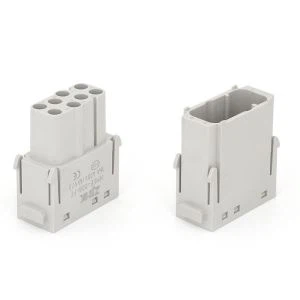
![HMEE 008 16A 400V Crimp Module Combined Terminal]() HMEE 008 16A 400V Crimp Module Combined TerminalFlexible Combination Heavy Duty Power Connector Insert, 8 Poles , 400V, 16A, Male, Crimp Terminal, Crimp Module. (Order Crimp Contacts Separately)Design drawingread more
HMEE 008 16A 400V Crimp Module Combined TerminalFlexible Combination Heavy Duty Power Connector Insert, 8 Poles , 400V, 16A, Male, Crimp Terminal, Crimp Module. (Order Crimp Contacts Separately)Design drawingread more -
![4 Pin Add 2 Signal Contacts Combined Industrial Inserts]() 4 Pin Add 2 Signal Contacts Combined Industrial InsertsInserts, Screw termination, Male/Female, Polycarbonate (PC), RAL 7032 (pebble grey), Rated current: 80 A, Size: 16 B, Contacts: 4, + 2 additional signal contacts, Conductor cross-section: 1.5 ... 16read more
4 Pin Add 2 Signal Contacts Combined Industrial InsertsInserts, Screw termination, Male/Female, Polycarbonate (PC), RAL 7032 (pebble grey), Rated current: 80 A, Size: 16 B, Contacts: 4, + 2 additional signal contacts, Conductor cross-section: 1.5 ... 16read more -
![4 Pin 80A 830V Combined Industrial Inserts]() 4 Pin 80A 830V Combined Industrial InsertsBrand: ZJHK Electrical. Product Code: HK-004/0-M / HK-004/0-F. Availability: In Stock.read more
4 Pin 80A 830V Combined Industrial InsertsBrand: ZJHK Electrical. Product Code: HK-004/0-M / HK-004/0-F. Availability: In Stock.read more -
![16 PIN Rectangular Industrial Connector Insert]() 16 PIN Rectangular Industrial Connector InsertZJHK HE® Industrial Connectors are suited for the harshest requirements in industrial environments. They are used in all applications requiring a safe and removable electrical connection.read more
16 PIN Rectangular Industrial Connector InsertZJHK HE® Industrial Connectors are suited for the harshest requirements in industrial environments. They are used in all applications requiring a safe and removable electrical connection.read more -
![16A 830V Protected Module Crimp Inserts]() 16A 830V Protected Module Crimp InsertsHVME Protected module, crimp male Details View Assembly Drawing Any purchase intention or want to know more about us, please contact our professional sales staff. We will do our best to serve you.read more
16A 830V Protected Module Crimp InsertsHVME Protected module, crimp male Details View Assembly Drawing Any purchase intention or want to know more about us, please contact our professional sales staff. We will do our best to serve you.read more


Why Choose Us?
Quality products
2018 introduced into automated production, Obtained IS09001 management system certification, the product meets the Rohs 3.0standard.
Rich experience
Established in 2012 our company focusing on the development and manufacture of heavy-duty connectors.
Reliable service
HAOKE's goal is to provide uniformly good services and to drive these forward through a passion for innovation, internationalisation and future-oriented thinking.
Surpassing innovation
Haoke was formally established, focusing on the development and manufacture of heavy-duty connectors. Haoke had obtained CQC, CE, UL, CUL, ROHS and other certifications and obtained further recognition.
In most industrial systems, connectors are required to transmit signals from the cables to other devices or parts of the machinery. These connectors need to be extremely robust. They should be able to withstand extreme conditions, while still ensuring that the connection is not compromised at any point.
Attributes of Industrial Connector
Attributes of a connector that can be used in Industrial Applications.
When going for connectors to be used in industrial applications, look for the below attributes:
● Waterproof and dust-resistant.
● Shock-resistant.
● Easy to clean and maintain.
● Compact size.
● Durable.
● Should work in high-pressurized or vacuum conditions.
● Able to withstand extreme temperatures.
● Hermetically sealed and a good IP rating.
Applications of Industrial Connectors
Industrial connectors are required to transmit signals from cables to other devices or parts of the machinery in most industrial systems. Largely because of the different classes, groups, or types of industrial connectors available, not all of them can be applied for the same requirements.
Industrial Applications: Never have industrial manufacturing engineers, machine builders, and control panel fabricators been under greater pressure to build reliable and robust interconnected devices. The increase in automation and applications requiring internet connectivity means more connector needs. This makes the industrial environment extremely demanding for connectors, as they are subject to mechanical, chemical, and even electrical stresses like extreme temperatures, vibration, shock, and corrosive elements.
Military Applications: Connectors built for military applications are expected to withstand high-impact shock, corrosion, & extremely changing temperatures, in addition to other combat conditions. These types of connectors for military applications are designed to operate over a wide temperature range and possess more powerful capabilities.
Communications Applications: For optimized and reliable performances in data and network servers, routers, monitors, storage systems, support equipment, and other computer peripherals, rugged connectors and cable assembly solutions are undebatable.
Medical Applications: In medical equipment and devices, cables and connectors serve as a medium for transmitting power, data, and control signals. These industrial connectors and cables can be found in various clinical settings including surgical devices, and therapeutic and diagnostic equipment.
Transportation Applications: Connectors for mass transit, railway, off-road heavy equipment, and commercial marine applications must be rugged and be able to withstand demanding requirements such as being accommodating to extremely harsh environments and resistant to mud and corrosion. These connectors are also essential for applications that require high reliability, such as lighting, doors, sensors, and brakes.
Factors to Be Considered in Choosing a Suitable Industrial Connector
Application environment: Different application environments have different performance requirements for connectors, and it is necessary to select a suitable connector according to the actual situation. For example, environmental factors such as high temperature, low temperature, humidity, dryness, corrosion, etc. will affect the performance of the connector.
Voltage and current: The rated voltage and current of industrial connectors are important factors to consider when selecting. According to the voltage and current requirements of the circuit, select industrial connectors that meet the requirements to ensure the normal operation of the electrical system.
Frequency: For signals that require high-frequency transmission, it is necessary to select industrial connectors with good high-frequency performance to ensure stable transmission of signals.
Physical size and spacing: The physical size and spacing of industrial connectors need to be selected according to the actual application scenario. In compact equipment, you need to choose miniaturized, high-density industrial connectors to save space, in spacious environments, you can choose larger connectors to meet the requirements of mechanical strength and reliability.
Safety factors: When choosing industrial connectors, safety factors also need to be considered. Safety features such as anti-mis-insertion design and high-voltage sealing performance can effectively guarantee the safe operation of the electrical system.
Importance of Industrial Connector
The connector is mainly used to connect data, signals and power between network equipment and mechanical facilities. It is inseparable from it in daily life and industrial production. Compared to indoor wall sockets, industrial connectors are often used in harsher environments, but we usually don't notice them.
In terms of rail transit, such as moving cars or high-speed trains, how can you make more stable calls, browse the web faster, or watch high-definition programs? Those who are often in a daze on the train must know how important this is, and military grade electrical connectors are responsible for the stable transmission of signals, so that you can enjoy smooth network signals. When watching a match, such as a tennis match, the connector can be installed on the referee chair and connected to the referee's computer to ensure normal power supply and communication. It can be said that the game went smoothly, and the connector contributed.
For popular rock concerts, theater shows, or musicals, military power connectors can provide reliable and robust signal transmission, and an exciting performance cannot be separated from it. In power plants, especially in outdoor switchgear, industrial connectors play their unique role. Constant exposure to sunlight, wind, dust, rain, and ice provides a secure connection to the control cabinet.
In the technical field of robots, connectors are also indispensable. Thanks to connectors, robots are easier to operate and easier to automate. The connector can also be used on CNC controlled 3-5 axis machining centers, boring, milling, drilling machines. Multi-axis linkage CNC system is also inseparable from the connector, which is used to open USB, TCP / IP network DNC processing and data transmission.
Industrial connector connectors are used in lathes, plastic processing machinery, printing presses, metal processing and wood processing machinery, electric cranes, semiconductor production equipment, food, and beverage processing and packaging machinery to achieve power, signal and data machine connection.
Connectors, as an electromechanical component, play a huge role in our lives, providing a bridge to connect systems, subsystems or components, transmitting signals or energy. They are indispensable products for electrical and electronic products. Connection to the other shore.
Characteristics of Industrial Connectors
High reliability: Industrial connectors adopt strict quality control and reliability testing in the design and manufacturing process to ensure that they can maintain stable performance in various harsh environments.
High durability
Industrial connectors are made of high-quality materials with good wear resistance, corrosion resistance, and oxidation resistance, which can ensure long-term use without failure.
Anti-mis-insertion function
Industrial connectors usually have an anti-mis-insertion design to ensure the correct docking of plugs and sockets and prevent electrical failures and safety problems caused by mis-insertion.
High-pressure sealing performance
Industrial connectors are designed with high-pressure sealing performance in mind, which can maintain sealing in high-pressure environments and prevent leakage of harmful substances such as arcs and gases.
Various specifications and models
Industrial connectors have various specifications and models to meet the requirements of different electrical parameters such as voltage, current, frequency, etc., and can also adapt to the needs of different application scenarios.
The following are some of the key aspects of the market for industrial connectors:
● Diverse Applications: Industrial connections have a wide variety of uses, including but not limited to manufacturing, automation, robotics, transportation, energy, and other fields and industries. They play an essential part in ensuring the smooth operation of all of the machinery and systems used in industrial settings.
● Specialized Varieties: Varieties Tailored to Specific Needs There are various varieties of industrial connectors, each of which is designed to meet a particular set of needs. While the primary purpose of certain connectors is to facilitate data transfer, others are geared toward the transmission of power.
● Durability and Reliability: Industrial connectors are constructed to withstand extreme environments while maintaining a solid connection. Both of these qualities contribute to the connectors' overall durability. They frequently come equipped with characteristics like Ingress Protection, or IP, ratings, which indicate how well they can withstand dust and moisture.
● Industry-Specific Standards: Standards That Are Unique To Each Industry Each industry may have its own set of standards and regulations that industrial connections must adhere to in order to guarantee both their safety and compatibility. Connectors are frequently designed by manufacturers to conform to the aforementioned criteria.
● Market Growth: The expansion of the market is being driven by developments in industrial automation, the introduction of Industry 4.0, and the growing requirement for connectivity and the sharing of data in industrial processes. It is anticipated that there will be a rise in demand for industrial connectors as businesses continue to implement cutting-edge technologies.
The market for industrial connectors is a dynamic and evolving sector that plays an essential role in enabling the modernization and efficiency of manufacturing processes across a variety of different industries. Because it comprises such a diverse set of products and technology, it is an indispensable component of the landscape of the industrial and manufacturing sectors.
Designing Industrial Connector for Rugged Environments
Today's electronic systems require industrial connector to supply both power and data between subsystems, but not all industrial connector are created equal. industrial connector intended for deployment in harsh environments need to be carefully evaluated to ensure they perform as expected in the end application.
In addition to environmental considerations, these industrial connector must offer a balance between power handling and signal integrity in advanced applications like robotics and embedded computing. Yet another aspect of selecting rugged industrial connector is form factor; some rugged industrial connector may be too bulky for the system being designed, but smaller form factors may be too delicate for the intended application.
Common operating conditions for rugged industrial connector can include:
● Extreme temperatures
● Exposure to contaminants like water and dust
● Exposure to corrosive liquids or gasses
● Exposure to radiation
● Emission and reception of electronic noise
● High or low pressure environments
● Deployment in areas with high vibration
The first place to start when selecting rugged industrial connector is to consider where the end unit will be deployed, namely environmental conditions and exposure to corrosive substances.
Ruggedized industrial connector that are to be used in outdoor environments must be sealed against moisture, dust, and other external contaminants.
Connector materials and finishes are also an important point of consideration as exposed surfaces could corrode over time. In shielded systems, such as in certain industrial settings,
industrial connector with a stainless steel or aluminum shell are usually the best choice.
Alternatively, industrial connector using advanced plastic compounds may be very useful in non-shielded applications where extreme corrosion is a risk.
Contact specifications are important for products that require high reliability in industrial-grade, power applications. Both contact size and wire gauge will determine the industrial connector amperage capacity (typically 10 to 40 amps), and larger contact sizes will be required when a system's power requirements exceed 5 amps in any given circuit.
Designers need to balance the space requirements of a physically larger connector (with its added weight and mounting requirements) with the actual power requirements of the system.
In harsh mechanical environments, industrial connector or cables may experience jerks or pulls that cause them to be disconnected or damaged. Most ruggedized connector systems include robust mechanical locking systems to prevent against disconnect or damage. Alternatively, there are retention mechanisms included in some connector housings that allow a connection to be broken once a certain amount of force is applied.
In addition to mechanical retention, industrial connector are available with a wide range of keying features to ensure proper mating orientation and to prevent crossed connections in multiple connector & cable bundle applications.
Some systems have very high EMI/EMC requirements on conducted noise or ESD, which are enforced in industry standards. This is certainly a concern for rugged industrial connector that need to carry high speed digital data.
Shielded industrial connector are an option that can help block external noise, but they may not be enough to pass EMC testing for demanding applications. Shielded industrial connector will often be used with a braided cable that provides additional radiation reception/emission suppression. These industrial connector can also provide the same sealing and corrosion resistance benefits as other cables that may not be electrically shielded.
Industrial connector play a significant role in the delivery of high-reliability performance and connectivity across an extensive range of applications. Among those include data centers, which are responsible for managing and storing a wealth of information and data that help drive operations globally each day. Because these types of connectors are designed to meet specific application needs, here are the most important factors to consider when selecting industrial connector for data centers.
● Electrical Requirements
When choosing a high-power connector, it is important to first carefully review whether its electrical and technical specifications meet the requirements necessary for your data center to perform optimally. One crucial spec to pay close attention to is the connector's power rating, including maximum voltage and amperage that it is designed to handle. It is also critical to determine the connector's maximum operating temperature since an increase in temperature above the maximum will reduce the rated power for the connector. This derating factor will help determine how to specify the proper power rating for a given application in the data center. Connectors should be specified so that their maximum power rating is higher than the environmental and electrical characteristics they are likely to be subjected to in the data center equipment. This is known as the design margin or the safety margin, which will have the effect of increasing the connector's reliability and performance by not subjecting it to electrical overstress.
● Mechanical Requirements
Equally as important as the electrical specifications of any high-power connector are its mechanical characteristics. This includes the device's dimensions, measurements, and design features – all of which pose certain limitations that can affect installation of the connector and its performance within the data center application. For this reason, it is imperative to consider the connector's form factor and profile to determine whether it is compatible with the data center's configuration. industrial connector are required to handle high voltage and high current electrical loads, which in turn requires that the connections have adequate separation from each other, and from other devices in the system to prevent unwanted electrical contact or interference. Further, the cables connected to these connectors should be properly specified to handle the maximum rated voltage and current of the connector, using a similar design margin, or derating factor to specify the cables.
● Quality Assurance
After the mechanical requirements are assessed, the next step is to determine whether the high-power connector in consideration has undergone extensive testing and quality assurance to prove that it satisfies the most stringent safety standards necessary for the data center to operate at optimum performance. Depending on the specific connector application within the data center, different safety standards can apply, both for the connector as a component, as well as for the overall circuit and system in which it is installed. Examples include materials used, blade/prong configuration, current rating, and whether they have a locking feature. Because the field environment in which the data center systems operate will also affect the reliability and functionality of the connector, especially over the course of its life cycle, some indicated tests are required to satisfy those differing environmental conditions. Examples of such tests include high humidity tests, which are required for applications requiring a waterproof function, or corrosive tests, which are mandatory for high pollution environments.
Our Factory
Haoke Electric Co., Ltd. was formally established, focusing on the development and manufacture of heavy-duty connectors. And soon thereafter, the HAOKE® connector made its convincing market debut and went on to set a globally recognised standard. He has remained the backbone of the Technology Group during all its changes.


Our Certificate


FAQ
We're well-known as one of the leading industrial connector manufacturers and suppliers in China. Our factory offers the best industrial connector made in China with competitive price. Welcome to place an order.
16 Pin Rectangular Industrial Connector Insert, Heavy Duty Power Connector, Heavy Duty High Density Insert Connector