

-
![40A 12 Pin Rectangular Industrial Connector]() 40A 12 Pin Rectangular Industrial ConnectorZJHK Heavy Duty Power Connector Insert,HK-012/2-FC , 12(Power)+2(Signal) + PE, 40A(Power)/10A(Signal), 690/250V, Female, Crimp Terminalread more
40A 12 Pin Rectangular Industrial ConnectorZJHK Heavy Duty Power Connector Insert,HK-012/2-FC , 12(Power)+2(Signal) + PE, 40A(Power)/10A(Signal), 690/250V, Female, Crimp Terminalread more -
![6 Pin Add 36 Pos Signal Connector Inserts]() 6 Pin Add 36 Pos Signal Connector InsertsInserts, Crimp termination, Male, Polycarbonate (PC), RAL 7032 (pebble grey), Rated current: 40 A, Size: 16 B, Contacts: 6, + 36 additional signal contacts, Conductor cross-section: 1.5 ... 6 mm²,read more
6 Pin Add 36 Pos Signal Connector InsertsInserts, Crimp termination, Male, Polycarbonate (PC), RAL 7032 (pebble grey), Rated current: 40 A, Size: 16 B, Contacts: 6, + 36 additional signal contacts, Conductor cross-section: 1.5 ... 6 mm²,read more -
![16 Poles Rectangular Inserts Match for Harting]() 16 Poles Rectangular Inserts Match for HartingSocket inset ZJHK® HE 09 33 016 2601 & 09 33 016 2701 ZJHK 16 + PE Screws 1 pc(s)Heavy industrial connectors for the toughest requirements in automotive, machine and plant engineering.read more
16 Poles Rectangular Inserts Match for HartingSocket inset ZJHK® HE 09 33 016 2601 & 09 33 016 2701 ZJHK 16 + PE Screws 1 pc(s)Heavy industrial connectors for the toughest requirements in automotive, machine and plant engineering.read more -
![4 Pin Add 2 Signal Contacts Combined Industrial Inserts]() 4 Pin Add 2 Signal Contacts Combined Industrial InsertsInserts, Screw termination, Male/Female, Polycarbonate (PC), RAL 7032 (pebble grey), Rated current: 80 A, Size: 16 B, Contacts: 4, + 2 additional signal contacts, Conductor cross-section: 1.5 ... 16read more
4 Pin Add 2 Signal Contacts Combined Industrial InsertsInserts, Screw termination, Male/Female, Polycarbonate (PC), RAL 7032 (pebble grey), Rated current: 80 A, Size: 16 B, Contacts: 4, + 2 additional signal contacts, Conductor cross-section: 1.5 ... 16read more -
![4 Pin 80A 830V Combined Industrial Inserts]() 4 Pin 80A 830V Combined Industrial InsertsBrand: ZJHK Electrical. Product Code: HK-004/0-M / HK-004/0-F. Availability: In Stock.read more
4 Pin 80A 830V Combined Industrial InsertsBrand: ZJHK Electrical. Product Code: HK-004/0-M / HK-004/0-F. Availability: In Stock.read more -
![16 PIN Rectangular Industrial Connector Insert]() 16 PIN Rectangular Industrial Connector InsertZJHK HE® Industrial Connectors are suited for the harshest requirements in industrial environments. They are used in all applications requiring a safe and removable electrical connection.read more
16 PIN Rectangular Industrial Connector InsertZJHK HE® Industrial Connectors are suited for the harshest requirements in industrial environments. They are used in all applications requiring a safe and removable electrical connection.read more -
![6 PIN Rectangular Industrial Connector]() 6 PIN Rectangular Industrial ConnectorHeavy-duty connectors are used wherever there is a need for a secure, simple and time-saving assembly of machinery and facilities.read more
6 PIN Rectangular Industrial ConnectorHeavy-duty connectors are used wherever there is a need for a secure, simple and time-saving assembly of machinery and facilities.read more -
![10 PIN Rectangular Industrial Connector Insert]() 10 PIN Rectangular Industrial Connector InsertWe look forward to your inquiry and we will get back to you within 24 hours.And to provide you with the perfect solution.read more
10 PIN Rectangular Industrial Connector InsertWe look forward to your inquiry and we will get back to you within 24 hours.And to provide you with the perfect solution.read more -
![24 PIN Screw Insert Rectangular Industrial Connector]() 24 PIN Screw Insert Rectangular Industrial ConnectorHeavy industrial connectors for the toughest requirements in automotive, machine and plant engineering.read more
24 PIN Screw Insert Rectangular Industrial ConnectorHeavy industrial connectors for the toughest requirements in automotive, machine and plant engineering.read more -
![32 Poles Rectangular Termination 09330162601]() 32 Poles Rectangular Termination 09330162601From Haoke, this HE Series insert is for use in 16 A heavy-duty power connector assemblies. With 32 positions, this insert has robust screw termination for wire sizes of up to 14 AWG.read more
32 Poles Rectangular Termination 09330162601From Haoke, this HE Series insert is for use in 16 A heavy-duty power connector assemblies. With 32 positions, this insert has robust screw termination for wire sizes of up to 14 AWG.read more -
![Similar Han E 48 PIN Rectangular Industrial Connector]() Similar Han E 48 PIN Rectangular Industrial ConnectorZJHK industrial connectors are suitable for all applications that require a safe and removable electrical connection in protected electrical areas.read more
Similar Han E 48 PIN Rectangular Industrial ConnectorZJHK industrial connectors are suitable for all applications that require a safe and removable electrical connection in protected electrical areas.read more -
![Replace Han EE 10 PIN Rectangular Industrial Connector]() Replace Han EE 10 PIN Rectangular Industrial ConnectorThese ZJHK® HEE inserts are rated at 16A. They are intended for use with hoods and housings contained within ranges 5, 6, 7, & 8. These hood and housing ranges are associated to a specific ZJHKread more
Replace Han EE 10 PIN Rectangular Industrial ConnectorThese ZJHK® HEE inserts are rated at 16A. They are intended for use with hoods and housings contained within ranges 5, 6, 7, & 8. These hood and housing ranges are associated to a specific ZJHKread more


Why Choose Us?
Quality products
2018 introduced into automated production, Obtained IS09001 management system certification, the product meets the Rohs 3.0standard.
Rich experience
Established in 2012 our company focusing on the development and manufacture of heavy-duty connectors.
Reliable service
HAOKE's goal is to provide uniformly good services and to drive these forward through a passion for innovation, internationalisation and future-oriented thinking.
Surpassing innovation
Haoke was formally established, focusing on the development and manufacture of heavy-duty connectors. Haoke had obtained CQC, CE, UL, CUL, ROHS and other certifications and obtained further recognition.
Rectangular connectors are now commonly used in modular machine design, factory automation, robotics, rail transportation and power generation to optimize signal integrity in applications with limited internal space. Engineered to optimize signal integrity in applications with limited internal space. Design flexibility and ease of handling are noted benefits of rectangular connectors.
Most rectangular connectors are modular and user-configurable and capable of carrying multiple different signals and allows connection of a "board-to-board", "cable-to-board" or "cable-to-cable" connection.
What Are the Benefits of Rectangular Industrial Connector
Rectangular industrial connector are designed to offer flexible, affordable, and user-friendly performance that can be relied upon to deliver in the long term. Here are just a few of the benefits this technology offers:
Robust and simple to install, being easy to fit the right way round and offering the additional security of in-built locking mechanisms.
Highly modular, meaning they can be configured by the user to provide multiple different signals according to your specific needs.
Cost-effective, generally cost much less to produce than circular connectors and allowing a single modular rectangular connector to replace multiple circular components.
Space-efficient, as a single connector can be configured to do the job of several, resulting in a simpler cable layout.
A wide range of options, catering for a huge variety of cable types, termination types, and modular variations helps you customise your rectangular connector for your requirements.
By taking advantage of the benefits of rectangular industrial connector, you will have greater control of how your industrial and network connections are organised, allowing you to design a highly efficient, reliable, and secure setup.
Industrial rectangular connectors have been a mainstay of heavy-duty and automation applications since the 1950s. Tomorrow's rectangular automation connectors will look much the same as they do today — on the outside. But inside, these connectors are becoming more powerful, capable, and versatile.
The foundational need for proven durability ensures that tomorrow's industrial rectangular connectors will look much the same as they do today. But the range of internal options that define the connector platform's versatility will expand to include next-gen connectivity features like RF, communications, fiber optic modules, switches, and more. These features will be introduced alongside the signal, power, fluidic, and pneumatic connections so popular today.
A key advantage of modular rectangular connectors is their backwards and forwards compatibility. The pace of innovation in the automation arena has already started to accelerate, but Industry 4.0 will take decades to fully implement. And many of the changes will be achieved through ongoing small and affordable steps that involve upgrading rather than replacing existing equipment.
As Industry 4.0 and the Industrial Internet of Things (IIoT) influence factory design, transformative technologies such as inductive power transport robots and point-to-point gigabit frequency RF systems will become part of manufacturing processes. It was originally designed to provide a rugged, high-performance connector that could be used in application areas across markets. This connector type replaced hardwiring with fast, easy connectivity, and with more than six decades of growth it is a mainstay of machinery, plants, wind turbines, rail applications, and shipboard equipment. Numerous connector suppliers offer a version of the rugged rectangular industrial connector.
As importantly, it allows for dummy placeholder modules that will enable engineers to increase the density of their legacy signal interconnects as well as retain space for next-gen modules. It doubles the number of modules that can fit into the standard rectangular shells.
The basic industrial rectangular connector has continued to evolve and thrive for main reasons:
Simplicity. The modular rectangular connector assembly has more than 100 unique component options, with thousands of potential interface variations. You don't need to retool everything just to introduce a new higher-speed industrial Ethernet link.
Cost. The next industrial revolution will accelerate upgrades as systems become more complex. Building upon a configurable system is more affordable than all-new wiring and components.
Field-proven and trusted. Rugged rectangular shells and contacts have been tested in the worst conditions and under decades of harsh cleaning protocols. The amperage ratings of the shells are confirmed for all variety of power configurations and temperature environments.
Choosing Industrial Rectangular Connector Components
When attempting to choose the connector insert, there are three things to be aware of: Conductor size, current requirement, and voltage requirement. A couple of additional considerations are overall size (including the space the protective housings may consume) and wire termination method, but there can be several other requirements that also come into play depending on the application.
Current and voltage specifications are straight forward and are given as a maximum value, usually at ambient temperature. The current specification should be accompanied by a derating curve based on temperature, so it's worth a look to see what can be expected of the insert at higher or lower temperatures. Voltage can be variable, based on the pollution degree applied to the spec, so depending on the scenario, that may be worth reviewing as well. Unlike the considerations taken when designing a circuit, the current and voltage specifications for a connector are independent of one another, meaning the max current rating does not change based on the applied voltage.
As for the wire size, you will need a contact that has a similar mass in comparison to the wire. If a certain amount of copper is required to carry an electrical transmission, then it's fair to say that the contact would need similar mass to carry the same transmission. Given that, expect that the contacts are going to be as large as, if not larger than, the wire itself. Plus, those contacts need to be spread out to proper creepage and clearance distances to prevent short circuits when in unmated condition.
Wire size also leads to another aspect that needs to be addressed: Termination method. While screw terminals and crimp contacts are the most common, there are a variety of methods available on the market. Spring contacts are ever-increasing in popularity, especially as the mechanisms have been and continue to be refined to be more reliable and secure, even surpassing screw terminal reliability. There is also IDC, or Insulation Displacement Connection, which provides quick and easy wire connection. Choosing the termination method can make a big impact on productivity and quality, though it's important to recognize that not every termination method will be available once other factors are considered.
Crimp contacts are great for large-volume production, especially when available in reeled form to facilitate automated crimping, though it is possible to automate the crimping of machine-turned contacts as well. Stamped-and-formed contacts (or punch-rolled) are easily provided on reels, and often accept a range of wire sizes.Because the retention method for holding the contacts in the insert is contained tight within the contact, this type of wire termination can also yield the highest density, meaning more wires can be stacked into a smaller overall package.
The Basics Industrial Rectangular Connector
Heavy-duty rectangular connectors are generally acquired in several pieces that can be mixed and matched to create an almost endless number of different connector configurations. This is incredibly helpful, given the number of different connection requirements across power, signal, and data transmissions. It can also be incredibly mind-numbing to try to figure out how to choose the right components for the application and be certain they all fit together.
It's important to recognize that there are generally three component types to consider: Connector inserts, housings, and cable entry. Together, they will form a complete connector assembly that should match all the electrical, mechanical, and environmental requirements for the target application. All component types will be impacted by each of those requirement categories, but primarily, inserts will address electrical requirements, while housings and cable entry will focus more on mechanical and environmental requirements.
The connector inserts are at the heart of your connection. This is where you will be adding the parts that physically merge the wires you want to connect. This will be true regardless of the type of transmission you wish to convey over those wires, though transmission type and ultimately the electrical specifications will be important when choosing the type of insert for the connection.
The housings are the main carrier for the inserts, as well as the primary means of protecting the inserts from the environment. Knowing the environment in which the connectors will be used will be very important in determining the protection level that housing will need to provide.
The cable entry is going to be the transition point for the cable as it enters the housing, and finally, the inserts. Up to this point, the cable (or hose/conduit) managed its own protection from the environment. However, once inside that housing, that self-contained protection will be stripped away in order to allow the individual wires to be terminated into the insert. The housing protects the wires after they are exposed, but the cable entry is needed to effectively relay the protection from the cable, hose, or conduit to the housing.
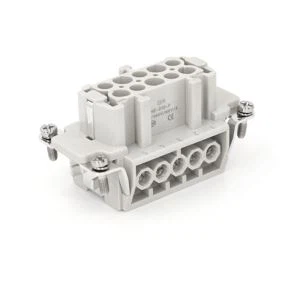
Rectangular industrial connector offer many advantages, such as design flexibility and ease of use, over other connector shapes. Their shape is ideal for efficient use of panel space in applied systems and their various options for material composition allow them to fulfill many different weight requirements. rectangular industrial connector are used in rack and panel, cable-to-cable, and panel mounting applications. Additionally, their robust design allows them to be used in industries including aerospace, defense, marine, industrial, and more.
Power and Hybrid connectors come in a wide array of shapes and sizes and with various abilities, options, and accessories. The purpose of a power connector is to serve as the important connection between an operating device and its power source. The diversity of power and hybrid connectors allows users find the exact type of power connectors needed for their specific applications. Many power and hybrid connectors boast low contact resistance, an environmentally conscious feature that saves energy by reducing the amount of energy converted to heat during operation.
Rectangular industrial connector can be used to meet the needs of power distribution and/or data transfer. Their broad range of size and material options allow them to be used in a number of systems. Some of the areas where rectangular industrial connector can be found are in military equipment, industrial instrumentation, ground support devices and computer equipment. They can also be found in consumer electronics, telecommunications systems, medical equipment and local area networks (LANs). rectangular industrial connector are available in a variety of shell sizes and pin-outs and can also be used in Line Replaceable Modules (LRM). Their contacts can be non-removable or removable, and feature the options of crimp, solder cup, or PC tail in low-to-high density configurations.
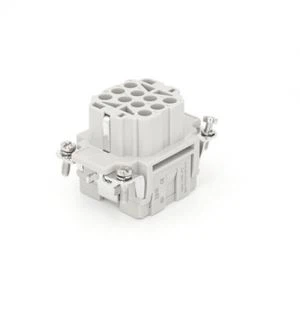
Rectangular industrial connector consist of a series of inserts and contacts contained within a plastic or metal housing. They are capable of transmitting power, signal, and data from one device to another, or connecting two cables together as part of a larger connectivity network.
Encompassing a wide range of sizes and insert types, rectangular industrial connector are designed to offer straightforward, reliable, and robust connections, simply by inserting the 'male' plug component into a female 'socket' receiver. Because of their wider, broader design, rectangular industrial connector often come equipped with various locking mechanisms that are not seen on circular connectors, including lever action locks, central holding screws, latches, and toggles.
These connectors are highly versatile, with most series offering a variety of configurations to cater to a wide range of wire gauges and cable OD's (outside diameters).
Finding the right solution for your application is important, as some devices will require you to purchase a connector with the right size of contacts, while certain environments will benefit from a specific choice of plating material in order to avoid the risk of corrosion.
10 Things Must Be Considered in the Rectangular Industrial Connector Selection
Commonly used rectangular industrial connector types are relatively wide. Despite the many types, it is necessary to follow the selection of the following 10 points, including the main flow, impedance matching, shielding, versatility, cost, availability, and other fourteen criteria.
Flow rate: When selecting a connector of the power signal, it is more concerned about the traffic of the connector. We have to use a drop-down design while paying attention to the insulation withstand voltage between the pins.
Structure size: The outer dimensions of the connector are very important, and there is a certain spatial limit in the product, especially on a single board, and cannot interfere with other components. Depending on the space of use, the installation site selects the appropriate installation method and shape (straight, bend, T type, circular, square).
Impedance matching: Some signals have impedance requirements, especially radio frequency signals, which are more stringent for impedance matching requirements, and the impedance mismatch can cause signal reflection, which affects signal transmission. General signal transmission does not have special requirements for the impedance of the connector.
Shielding: With the development of communications products, EMC is increasingly valued. When the selected connector is required, there is a metal case while the cable requires a shield. The shield is to be connected to the metal housing of the connector to achieve the shield. It is also possible to use the injection molding method to wrap the plug site, and the shield of the cable is welded to the copper skin.
Anti-mistake plug: First, the connector itself rotates 180 degrees, misplaced error connection caused signal error connection. At this point, pay attention to selecting the anti-wrong plug connector as much as possible. It may appear on the plug to the B plug. At this time, it is necessary to pay attention, if so, it will be caused When severe consequences, the A and B interface must be selected as different types of sockets.
Reliability: The connector is used to connect the signal, so the connecting portion is reliable (eg, the surface contact is better than point contact, the pinhole is superior to the fluffy, etc.).
Versatility: Select a universal object as possible during the selection process of the connector, especially between the same series. The selection of the connector has strong versatility, reducing the type of material, increasing the number reduction cost while reducing the supply risk.
Usage: Connectors use special requirements for connectors when using environmental, salt, mold, cold, etc.
Locking function: When it occurs when the connector is released, the connector is required to have a lock function.
Plugging frequency: The connector has a certain life. After the number of plugs reaches the limit, the performance of the connector will decline.
Comprehensive consideration: In the process of selecting the connector, it is not independent and often interacts. Therefore, we should consider it in the connector selection process, choose the most suitable connectors, and the choice of quality will affect the product varying degrees at different stages.
Our Factory
Haoke Electric Co., Ltd. was formally established, focusing on the development and manufacture of heavy-duty connectors. And soon thereafter, the HAOKE® connector made its convincing market debut and went on to set a globally recognised standard. He has remained the backbone of the Technology Group during all its changes.


Our Certificate


FAQ
We're well-known as one of the leading rectangular industrial connector manufacturers and suppliers in China. Our factory offers the best rectangular industrial connector made in China with competitive price. Welcome to place an order.
Industrial Connector, 32 Poles Rectangular Termination 09330162601, 32 Pin Crimp Rectangular Inserts 09320323001