

-
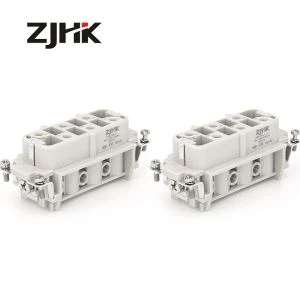
![HSB 6 PIN Heavy Duty Power Connectors]() HSB 6 PIN Heavy Duty Power ConnectorsWe have experiences for heavy duty connector 9 years and developed hundreds of insert and housing models, such as HA, HE, HEE, HD, HDD, HM, HK, HSB, HQ and H3A, H10A, H16A, H32A, H6B, H10B, H16B,read more
HSB 6 PIN Heavy Duty Power ConnectorsWe have experiences for heavy duty connector 9 years and developed hundreds of insert and housing models, such as HA, HE, HEE, HD, HDD, HM, HK, HSB, HQ and H3A, H10A, H16A, H32A, H6B, H10B, H16B,read more -
![12 PIN HSB Heavy Duty Power Connectors]() 12 PIN HSB Heavy Duty Power ConnectorsHaoke Heavy Duty Connector with rich product series are used wherever there is a need for a secure, simple and time -saving assembly of machinery and facilities.read more
12 PIN HSB Heavy Duty Power ConnectorsHaoke Heavy Duty Connector with rich product series are used wherever there is a need for a secure, simple and time -saving assembly of machinery and facilities.read more


Why Choose Us?
Quality products
2018 introduced into automated production, Obtained IS09001 management system certification, the product meets the Rohs 3.0standard.
Rich experience
Established in 2012 our company focusing on the development and manufacture of heavy-duty connectors.
Reliable service
HAOKE's goal is to provide uniformly good services and to drive these forward through a passion for innovation, internationalisation and future-oriented thinking.
Surpassing innovation
Haoke was formally established, focusing on the development and manufacture of heavy-duty connectors. Haoke had obtained CQC, CE, UL, CUL, ROHS and other certifications and obtained further recognition.
Heavy duty power connectors and accessories are robust electrical components designed for demanding industrial applications. These connectors facilitate high-current transmission, providing reliable and secure connections in challenging environments. Built with durable materials, they offer resistance to vibrations, shocks, and environmental factors. The connectors feature a modular design, allowing flexibility in configurations to accommodate various power requirements. Accessories, such as protective covers and cable glands, enhance the system's reliability by safeguarding against dust, moisture, and mechanical stress.
Advantages of Heavy Duty Power Connector
Achieve pre-installation, pre-installation of large and complex circuits, which can greatly improve the efficiency of equipment installation and reduce the rate of wiring errors.
Heavy-duty connectors provide highly integrated connections, and the rich combination methods maximize the effective utilization of equipment space.
Heavy-duty connector The connector conveniently and efficiently realizes the modular structure of each functional template block of the device, making the device convenient and safe for transportation, installation, maintenance and repair. Connectors are widely used in the field of power transmission and distribution.
The high degree of protection provided by heavy-duty connectors has unparalleled advantages for equipment connection systems in harsh environments. Provides effective protection in harsh environments such as sand, rain, cold, snow and ice.
Requirements for Heavy Duty Power Connector: Robustness, Stability, And Flexibility
Heavy duty power connector have outstanding and reliable performance in harsh environments. They are mainly used for the data, signal, or electrical connection between different equipment and functional units. Apart from enabling extremely convenient installation and maintenance for complex control equipment, their modular and standard interface design can maximize application efficiency.
With the rise of Industry 4.0, the demand for customization, stability, and integration of equipment increases in industry production
Heavy duty power connector consist of three key elements: inserts, contacts and hoods, and housings. The inserts and the contacts together form an electrical module for equipment electrical connection. The housing is made of either metal or thermoplastic with a robust structure to provide reliable mechanical and environmental protection for electrical connection. The water and corrosion resistance of the metal housing ensures that heavy duty power connector can work in any harsh environments and fulfill the outdoor connection demand of customers. Also offers a complete product range with current from 5A to 350A. The module range makes connection with custom interfaces a reality.
There are different kinds of connectors for different applications and different environments. As all these applications require electrical and signal connection in environments challenged by temperature, humidity, and long-term vibration that leads to connection loosening, heavy duty power connector are designed for use in harsh and complex environments to ensure the stable operation of the entire system.
Heavy Duty Power Connectors Market Analysis and Latest Trends
Heavy duty power connectors are robust and reliable electrical connectors used to transmit power in demanding industrial applications. These connectors are designed to withstand harsh environments, extreme temperatures, high levels of vibration, and heavy mechanical stress. They provide secure and efficient connections for large power cables, ensuring a safe and continuous power supply.
The market for heavy duty power connectors is projected to experience significant growth in the coming years. The increasing demand for reliable power transmission solutions in industries such as manufacturing, construction, energy, and transportation is driving the market growth. The rapid industrialization and infrastructure development in emerging economies also contribute to the market expansion.
The rising focus on renewable energy sources and electric vehicles further fuels the demand for heavy-duty power connectors. These connectors are essential for transmitting power from renewable energy sources like solar panels and wind turbines to the grid or for connecting charging stations to electric vehicles.
The adoption of advanced technologies like industry and iot in industrial applications is also impacting the heavy duty power connectors market. These connectors play a crucial role in enabling the seamless integration and communication of equipment and machinery.
Key trends in the heavy duty power connectors market include the development of connectors with higher current carrying capacity, increased use of modular connectors for flexibility, and the integration of safety features to prevent accidents and ensure worker protection.
The heavy duty power connectors market is expected to witness substantial growth with a cagr of % during the forecast period. The demand for reliable power transmission solutions, the focus on renewable energy sources and electric vehicles, and the adoption of advanced technologies are the primary drivers behind this market growth.
The definition of "harsh" varies significantly across the many operating environments that require automated processes. Some robots may be working in a highly controlled clean room or surgical suite, while others operate on a grimy, dusty, or contaminated factory floor. In both instances, they will face aggressive cleaning or sterilization agents, vibrations, extreme temperatures, welding sparks, gaseous environments, or electromagnetic interference.
For a robot to perform within its specified parameters, the controllers need accurate, real-time information on its position. If the position data flow is interrupted, the computer cannot accurately measure the position of the robot. Its assumptions may be inaccurate, and it may issue commands that lead to overreaching or overcompensating movements. Rugged interconnects that can protect the flow of power and data even under less-than-ideal conditions are essential to safe and reliable robot operation, and overall productivity.
Sensitive robotics and automated systems used in industrial environments face several types of challenges. High temperatures, for example, can gradually degrade component materials, which increases the potential for interruptions to the flow of power and data. Yet concentrated high temperatures are common in many environments where robotics are used. Injection molding machines, commonly experience temperatures up to 220° C.
The compatibility of electronic components with various cleansing agents and procedures should be considered when designing systems. Cleaning agents are frequently present in production or processing areas, usually under high pressure and temperature. These chemicals can be extremely harsh and corrosive to sensitive electronics. They are also application-specific.
Heavy-duty connectors (HDC) can help engineers meet both the requirements and the challenges of building robots for harsh industrial environments. Built in a rugged housing and designed to transmit power, data, and signal, HDCs help guarantee safe, reliable, and productive operation of robots in the toughest conditions. Modular HDCs are an ideal complement to hybrid cable systems, as they provide the ability to create a component that matches the exact needs of a unique or flexible design.

Potential fields of application for heavy duty power connector can stretch far and wide – such as general industrial automation, railway, automotive and commercial vehicle, marine and oil & gas sectors – generally whenever a strong connection is required. This makes heavy duty power connector a potential replacement to other kinds of connectors commonly used. Each operating environment requires the chosen connector to have resistance to varying levels of shock, vibration and temperature as well as the appropriate level of sealing protection from the ingress of dirt, dust, chemicals and other fluids.
A heavy duty connector comprises of four main parts:
1. The hood, which is the external plug cover of the connector, which includes specific metric, PG or NPT thread(s) and cable gland(s).
2. The housing, which is the component installed on panels and equipment,and the two inserts, which are the parts to assemble the cable wires.
3. Male insert is usually assembled into the hood.
4. Female insert into the housing. The thread on the hood should remain unpainted to guarantee a good ground connection when assembled with the cable gland.
At the core of any connector are the contacts within the inserts, as they carry power and signal. The choice of contact type, which is either silver, gold or tin plated copper alloy depends on what type of field service is required. Gold platings are used in signals with voltage and current lower than 5V and 5MA while for other applications the silver platings are commonly used.
Several types of inserts are available and one type can include screw and spring type contacts that are pre-installed into the inserts' body. Crimp type inserts carry turned or stamped contacts. The latter being typically distributed into reels of hundreds or thousands of pieces. Vibration and shock proof, this push-in system can reduce assembly time by as much as 80% over the standard screw types.
Technical Principles of Heavy Duty Power Connector
A heavy duty power connector is a detachable component (other than an adapter) that is usually mounted on a cable or device for electrical connection of a transmission line system.
That is, a device that connects two active devices and transmits current or signals. A connector is a motor system that provides a separable interface to connect two secondary electronic systems and does not have an unacceptable effect on the operation of the system.
A connector is a motor system because it is an electrical connection created mechanically.
The reason why heavy duty power connector are used in the first place is that the mating interface is separable. There are many reasons for the need for separability. It makes it possible to manufacture parts or subsystems independently and final assembly can be carried out in one main place. Separability also makes it possible to maintain or upgrade parts or subsystems without having to modify the entire system. Another reason separability is applied is portability and support for expansion of peripherals.
The separability in the definition introduces an additional interface between subsystems. This interface cannot introduce any "unacceptable effects", especially the characteristics of the system cannot be affected by telecommunications. Unacceptable distortion and signal degradation between systems, or power loss through heavy duty power connector, power loss calculated in millivolt losses, will become the primary design criteria for functionality, so the power requirements of the motherboard will also increase.
The need for separability and the limits of "unacceptability" depend on the application of the connector. Separability includes the number of mating cycles. The mating cycle refers to the force that a connector must provide without affecting its performance and the force necessary to cooperate with another connector.
Typical mating cycle requirements range from tens of cycles for internal heavy duty power connector to thousands of cycles for peripherals. Due to the increase in the number of circuits or functions and the interconnection of heavy duty power connector, the need for cooperating power becomes more important. In order to provide more functionality, the position of the terminals on the connector must also be increased, which results in a higher connector mating force. Depending on the use and function of the connector, the number of terminals varies from tens to thousands.
Identifying the Correct Heavy Duty Power Connector
Choosing the right heavy duty power connector is the first step, and there are a number of types of heavy duty power heavy duty power connector. Each heavy duty power connector has different uses, so let's explore each of them in detail:
Wire nuts: Wire nuts are used to join two or more wires together. Also known as 'twist-on heavy duty power heavy duty power connector', they come in various sizes and are color-coded to match the wire gauge they are intended to be used with. They are composed of a metal coil inside a plastic casing. The ends of two stripped wires are twisted together and inserted into the nut, which is twisted to further entwine the two wires.
Butt heavy duty power heavy duty power connector: Unlike wire nuts, with butt heavy duty power heavy duty power connector, wires are joined without touching each other, but rather by touching the heavy duty power connector. They are often used for extending wire lengths or connecting wires that need to pass through conduit or tubing. Two wires are joined in the middle of the heavy duty power connector, end to end, and then the heavy duty power connector is crimped to hold the wires in place. Some butt heavy duty power heavy duty power connector also work using heat shrinking.
Terminal blocks: Terminal blocks are another type of crimp heavy duty power connector, often used to connect multiple wires at a common point. These blocks are mounted on a panel and are used for organizing electrical connections. Some terminal blocks require you to crimp the wire to secure it, while others require you to attach a ferrule to the wire before inserting it.
Soldering: Soldering is a technique where the wires are joined by melting solder (a metal alloy composed of tin and another metal) over the stripped ends. Soldered connections are secure and provide low electrical resistance, but creating these connections requires specialty tools and skill.
Our Factory
Haoke Electric Co., Ltd. was formally established, focusing on the development and manufacture of heavy-duty connectors. And soon thereafter, the HAOKE® connector made its convincing market debut and went on to set a globally recognised standard. He has remained the backbone of the Technology Group during all its changes.


Our Certificate


FAQ
We're well-known as one of the leading heavy duty power connector manufacturers and suppliers in China. Our factory offers the best heavy duty power connector made in China with competitive price. Welcome to place an order.
Industrial Module Combined Inserts, Heavy Duty Industrial Module Connector, 32 Poles Rectangular Termination 09330162601